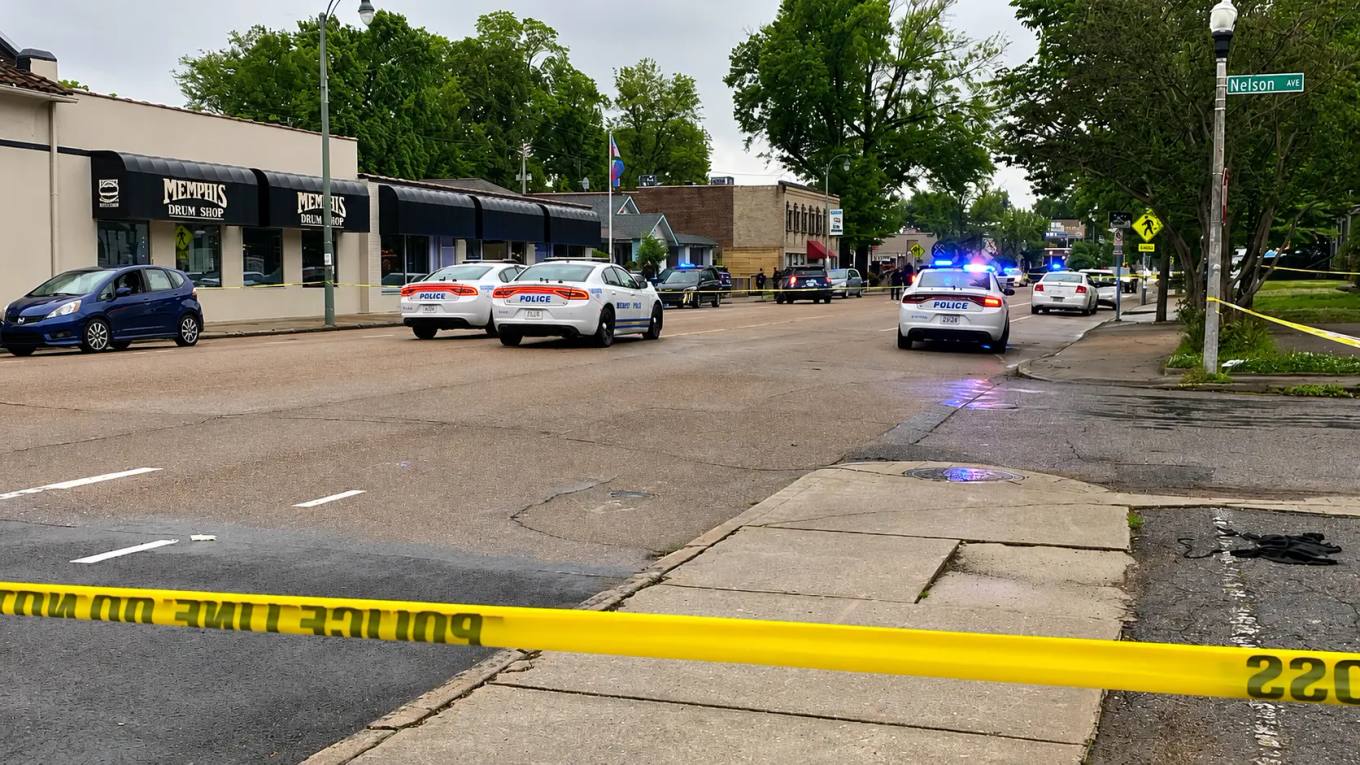
MEMPHIS, Tenn. - The Shelby County District Attorney's Office dropped all charges against Aljon Tyler in late July, roughly three months after she was arrested in the May 5 shooting outside OUTMemphis in Cooper-Young that critically injured two people.
Tyler, a Black transgender woman known as Adriana, was arrested less than 24 hours after the shooting and charged with three counts of attempted second-degree murder and possession of a firearm during the commission of a dangerous felony. She was released from the Shelby County Jail on her own recognizance in late July.
Early coverage of this case, including police accounts, used different pronouns and in some instances a different first name. This post follows the reporting that identified her as she and as Adriana.
The DA's office said it received new information and opened a new investigation. According to that office, a prosecutor and two Criminal Investigation Division investigators re-interviewed witnesses, located additional witnesses, and identified a different suspect. That work took 24 hours.
District Attorney Steve Mulroy said in a statement that doing justice means following the facts wherever they lead, and that when credible new information comes to light his office has a responsibility to act swiftly, thoroughly and fairly.
The new suspect has not been publicly named and no charge against that person has been announced. That person is entitled to the presumption of innocence.
The 24 hours and the three months
The DA's account contains its own most difficult fact.
Once prosecutors looked again, the case came apart in a day. Witnesses were re-interviewed, additional witnesses were found, and a different suspect was identified inside 24 hours.
Tyler was in custody for roughly three months before that day arrived.
What prompted the second look was not a police review. According to the DA's office, it followed new information from a criminal defense attorney and concerns raised by the community. Tyler's attorney, Sharon Morales, put it directly: "You really shouldn't have to prove your innocence," she said, adding that proving it was what they had to do.
Reporting indicates that people connected to OUTMemphis became adamant that the wrong person was in custody after seeing Tyler in court within days of the arrest. That was in May.
How the identification happened
Both surviving victims positively identified Tyler.
According to reporting, the victims told police they knew the shooter, who went by the name Jewel, from the local homeless community, and that they were certain Tyler was Jewel. Memphis police released a description of a suspect matching that account before the arrest.
Eyewitness identification is among the most persuasive evidence a jury hears and among the least reliable. Identifications made under stress, involving people known by a street name rather than a legal name, within a community where several people may be known by similar descriptions, are the conditions under which misidentification is most likely. That is not a criticism of the victims, who were shot and who believed what they said.
It is the reason identification procedure exists, and procedure is the accountability question here.
Why It Matters for Memphis
Nothing in the public record establishes that any officer did anything improper. The Memphis Police Department made an arrest supported by two victim identifications, which is ordinarily sufficient. The DA's office corrected the error and did so quickly once it looked. Both of those things can be true.
What has not been answered is the interval.
Did the community's concerns reach MPD in May, and if so, what happened to them? People close to OUTMemphis were reportedly adamant within days. If that reached the department, the question is what review followed. If it did not, the question is why an organization at the center of a case had no route to raise it.
What identification procedure was used? Whether a photo array or a show-up was conducted, whether it was double-blind, and whether the two identifications were independent of each other are documented facts in any investigative file.
Who bears the cost of three months? Tyler was jailed on charges the state no longer pursues. Shelby County operates that jail, and this newsroom has covered its conditions repeatedly this summer, including a chiller failure that sent 14 people for medical attention in June.
The 901 Report has requested none of these records and has not reviewed the investigative file. These are the questions the file would answer.
Accountability Watch
Who is accountable: The Memphis Police Department, which made the arrest and conducted the identification. The Shelby County District Attorney's Office, which brought the charges and later dropped them. Shelby County government, which operates the jail.
What is pending: Any MPD statement on the identification procedure or an internal review. Any charge against the newly identified suspect.
Timeline: Shooting at OUTMemphis on Cooper Street, May 5, 2026. Tyler arrested within 24 hours and arraigned May 7. Community concerns raised within days of the arrest. DA's office reopened the investigation in late July after new information from a defense attorney. Different suspect identified within 24 hours of that review. Charges dropped and Tyler released late July 2026.
Status as of August 6, 2026: Charges dropped. No public explanation of the three-month interval. No suspect publicly charged.
How to verify: The DA's office issued a public statement and can confirm the case disposition. The Memphis Police Department can be asked directly what identification procedure was used. Court records for the original charges and their dismissal are public. Any expungement petition would be a court record.