TENNESSEE
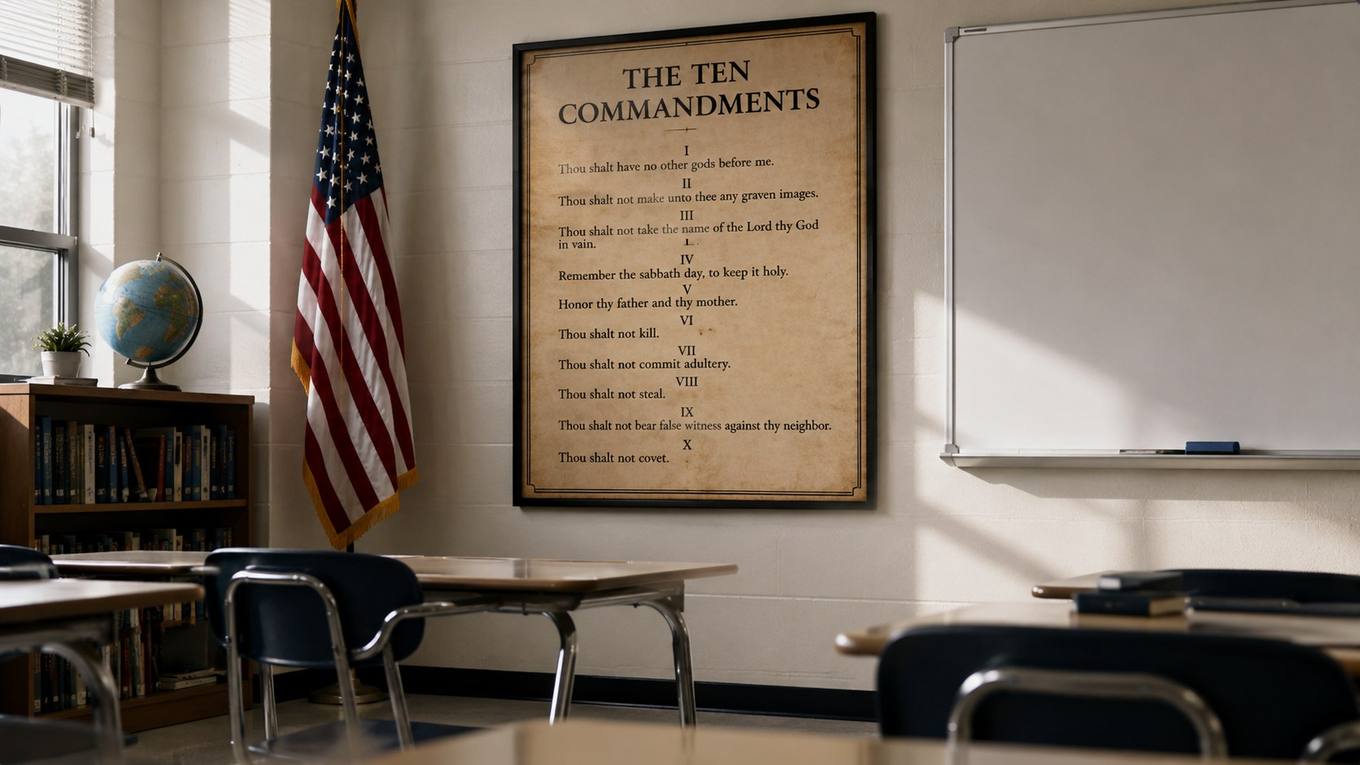
MEMPHIS, Tenn. - At least three Tennessee school boards have voted to display the Ten Commandments in schools under a state law that took effect July 1, according to the Tennessee Lookout.
Washington County's board voted most recently, reported August 6. Wilson County voted in July and Rutherford County in April.
The law, signed by Governor Bill Lee in May 2026, permits districts to display a state-approved text. It does not require them to. The statute specifies a minimum 26-point font and placement in prominent locations.
No legal challenge has been filed as of publication.
Why this reaches Memphis before anyone votes here
Seven public school systems operate in Shelby County: Memphis-Shelby County Schools and the six municipal districts in Bartlett, Collierville, Germantown, Lakeland, Millington and Arlington.
Each of the seven now holds the same authority Washington County just used. Each board can put the question on an agenda, and each board can decline to.
The 901 Report has identified no Shelby County board that has voted on a display, in either direction.
That makes this a story about a decision seven local bodies have in front of them rather than one they have made. It is also the reason to write it now: a board that takes this up should do so with residents knowing the vote is optional, that other districts have already voted, and that no court has yet ruled on the law.
The legal posture, stated carefully
A Kentucky statute requiring Ten Commandments displays in public school classrooms was struck down by the United States Supreme Court in Stone v. Graham in 1980, on the ground that it had no secular legislative purpose.
Tennessee's law differs in a way its drafters plainly intended: it permits rather than requires. Whether that distinction survives a challenge is an open question, and this newsroom does not know the answer. Similar display laws in other states have drawn litigation with mixed outcomes, and the legal landscape has shifted since 1980.
No court has ruled on Tennessee's statute. Anyone stating confidently that a display here is lawful or unlawful is predicting, not reporting.
What is knowable is who bears the cost if a challenge comes. A district that votes to display becomes the defendant. Legal defense of a school board is paid from that district's budget, which in the case of MSCS is a budget the Shelby County Commission has not yet approved and which is already the subject of a state forensic audit and a federal takeover fight.
Both arguments, as their proponents make them
Supporters argue the Ten Commandments are a foundational document in the development of Western and American law, that displaying a historical text alongside others is not establishment, and that the law leaves the choice to locally elected boards rather than imposing it from Nashville. The permissive structure is their answer to the constitutional objection.
Opponents argue that a state-approved religious text on a public school wall is a state endorsement regardless of whether the display is optional, that students are a captive audience, and that Stone v. Graham remains the governing precedent. They also note that a permissive law shifts legal exposure onto individual districts rather than the state that wrote it.
Both positions are held in good faith and this post does not adjudicate them.
Accountability Watch
Who is accountable: The seven public school boards in Shelby County, each of which holds the authority. The Tennessee General Assembly, which wrote the law. Governor Bill Lee, who signed it.
What is pending: Any Shelby County board vote. Any legal challenge to the statute.
Timeline: Rutherford County voted April 2026. Governor Lee signed the law May 2026. Law effective July 1, 2026. Wilson County voted July 2026. Washington County vote reported August 6, 2026.
Status as of August 7, 2026: No Shelby County board vote identified. No legal challenge filed.
How to verify: The statute's text and bill number are published at capitol.tn.gov. School board agendas and minutes are public records in every Tennessee district, including all seven in Shelby County. Board votes appear in the minutes.
Your city. Your money. Your receipts.