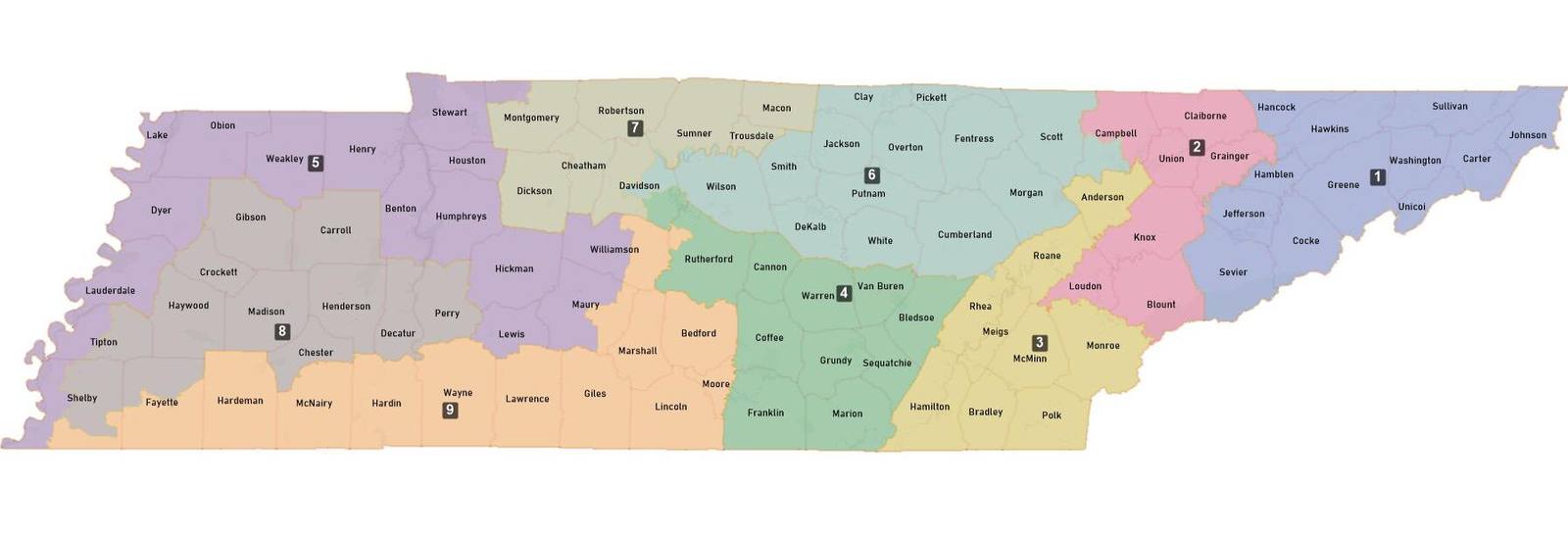
A three-judge panel has upheld Tennessee’s new congressional map, keeping Memphis divided across three congressional districts for now.[1][2] For Shelby County residents, the immediate question is whether the city’s political voice stays carved up or gets another day in court.[1][2]
The ruling came down Tuesday in a Chancery Court challenge brought by the NAACP, and both WPLN and NewsChannel 5 reported that the panel ruled against the plaintiffs on the map claims.[1][2] The map itself redraws the Memphis-based 9th Congressional District and spreads the city into three districts, a change that has already reshaped representation for the region.[1][3]
This is not just a political map fight. It is an accountability fight over who answers to Memphis voters, which neighborhoods get bundled together, and whether the city can be represented as a coherent bloc in Congress.[1][3] The legal outcome matters because redistricting decisions decide how easily residents can hold an elected official to account when the city’s population, priorities, and budget pressures are being split across multiple districts.[1][3]
The stakes are especially high because this map did not emerge in a routine redraw. Voting Rights Lab noted that Tennessee’s 2026 mid-decade redistricting followed a special session called by Gov. Bill Lee after the U.S. Supreme Court’s Louisiana v. Callais decision, and the state then approved a new map that redrew Memphis’s district lines.[3] That means the current map sits inside a broader political and legal fight over how far state leaders can go in redrawing representation between censuses.[3]
For Memphis, the practical effect is straightforward: the city remains split three ways unless a higher court changes the picture later.[1][3] That matters to council members, local advocates, and residents because it affects which congressional office hears complaints about flood relief, transit, housing, federal grants, and civil-rights enforcement, and it affects how much weight Memphis can bring as one place instead of three fragments.[1][3]
This ruling also lands after a string of related coverage on the same map fight, which has already become one of the most consequential accountability stories in Tennessee this month.[1][2][3] As we reported in previous 901 Report coverage, the core issue has never been just lines on a page. It is whether Memphis voters can still be spoken for with any clarity when the district map cuts the city apart.
Why this matters for oversight
The responsible actors are Gov. Bill Lee, the Tennessee General Assembly, and the state court panel that upheld the map, along with the congressional delegation that will operate under it.[3][1] Residents in Memphis and Shelby County should be asking whether the split leaves any single official clearly accountable for citywide federal issues, and whether the map gives Memphis enough shared representation to track promises, spending, and oversight across districts.[1][3]
What to watch next: whether plaintiffs appeal, whether any federal challenge gains traction, and whether the map stays in place through the next round of election planning and candidate filings.[1][3]