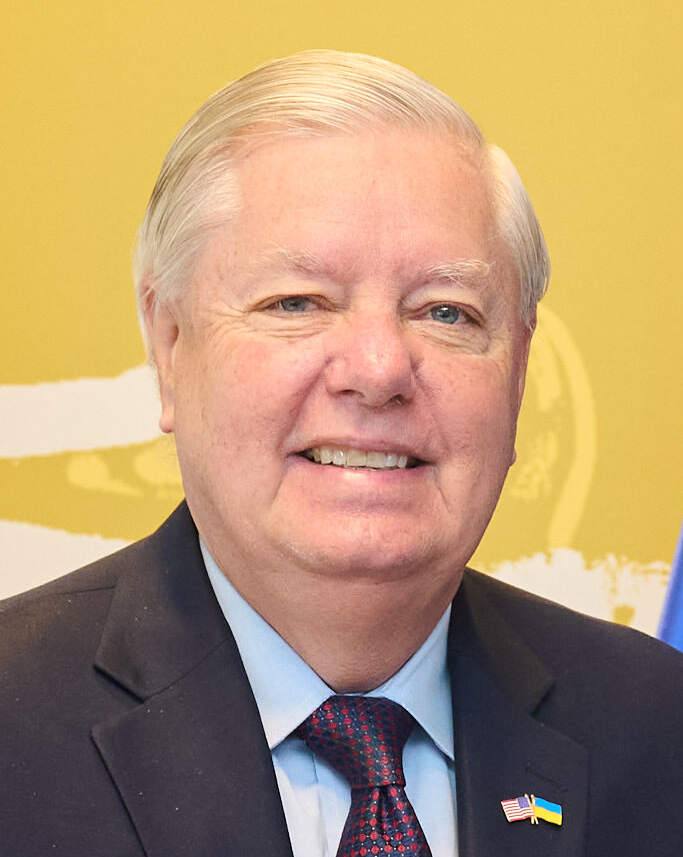
WASHINGTON - U.S. Senator Lindsey Graham, the South Carolina Republican who spent more than two decades in the Senate and became one of President Donald Trump's closest allies on Capitol Hill, died on Saturday evening, July 11. He was 71.
Graham's office announced the death in a statement posted early Sunday, saying he "passed away from a brief and sudden illness." The statement provided no further details, and said his family asks for prayers and privacy. A spokeswoman told reporters that Graham had recently returned from a trip to Ukraine and that more information would be released in the coming days.
The death was sudden by any measure. Graham had been in Kyiv as recently as Friday and was scheduled to appear on national television Sunday morning. He had turned 71 two days before he died.
Graham was elected to the Senate in 2002, succeeding Strom Thurmond, and took office in 2003. He had previously served a term in the South Carolina House and four terms in the U.S. House representing the state's 3rd congressional district. He was reelected to the Senate in 2008, 2014, and 2020, and was up for reelection this cycle.
In the Senate he chaired the Judiciary Committee from 2019 to 2021 and most recently chaired the Budget Committee. He built his national profile on foreign policy, advocating an interventionist posture abroad, pressing a hard line on Iran, and backing close ties with Israel. He was also a longtime advocate for U.S. support of Ukraine, the cause that took him to Kyiv in his final week.
His relationship with Trump defined the last decade of his career. Graham ran for the Republican presidential nomination in 2016 and withdrew before the primaries, and he was an outspoken critic of Trump's candidacy that year. After meeting with him in 2017, he became one of the president's most reliable defenders in the Senate.
Before entering politics, Graham served as a lawyer in the Air Force's Judge Advocate General's Corps, and he remained in the Air Force Reserve while in Congress, retiring as a colonel in 2015 after more than three decades of service.
Under South Carolina law, the governor will name an interim successor to fill the seat.