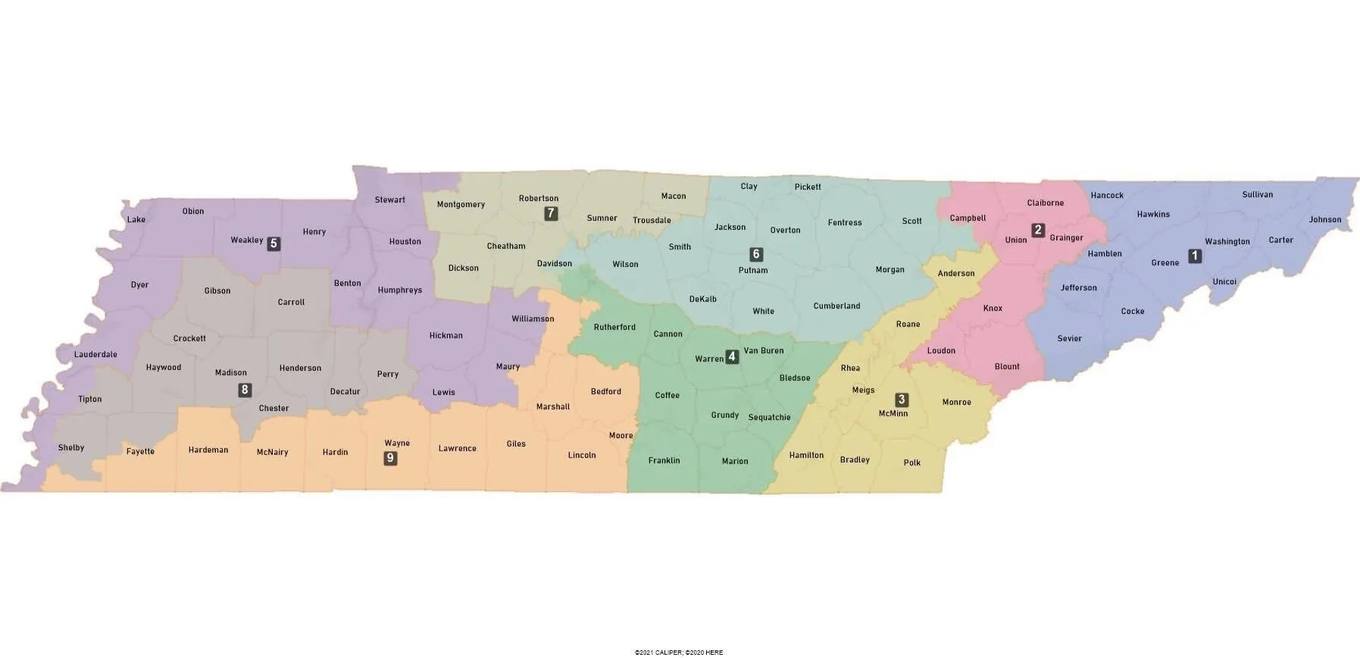
MEMPHIS, Tenn. - Tennessee's congressional map was redrawn in a three-day special session in May. Shelby County, which had been anchored in a single district, is now divided among three: the 5th, the 8th and the 9th.
The August 6 primary is the first election held under the new lines. Early voting is already underway.
The practical point comes first. The Tennessee Secretary of State publishes a free address lookup that will tell you which congressional district you now live in, along with detailed district maps drawn from the Comptroller's office. It is at sos.tn.gov, under 2026 Congressional Redistricting. If you have not checked, check. A voter who assumes they are still in the district they were in last year may be looking at the wrong race.
Two households on the same street can now be in different congressional districts. The pastor of Mississippi Boulevard Christian Church told NPR that his Midtown church and its second campus in the city's southeast corner are now in different districts.
What the new map does
The General Assembly adopted the revised districts during the Second Extraordinary Session of the 114th General Assembly in May 2026. Governor Bill Lee called the session and signed the map into law.
Under the previous map, the 9th District covered most of Memphis and its inner suburbs, was about 60 percent Black, and was the state's only majority-minority congressional district and its only Democratic-held seat. It had been represented by Steve Cohen since 2007.
The redrawn 9th begins in Memphis and extends across rural southern Tennessee, ending more than 200 miles away in suburban Williamson County south of Nashville. Under the new map, analysts have projected Republicans are favored in all nine of the state's districts.
An analysis published by the Nashville Banner found that no district in the state will have a majority-minority population under the new map, and that no district will reach even a one-third minority population based on 2020 census data. The same analysis found the median population density of the district that previously contained all of Memphis fell from 3,075 per square mile to 789, a decrease of about 75 percent.
The legislature also repealed a state law that had prohibited mid-decade redistricting, and reopened candidate qualifying until May 15 so candidates could enter or switch districts.
Why this happened when it did
The special session followed a United States Supreme Court decision issued about a week earlier that limited the use of race in drawing congressional districts. Tennessee was the first state to pass a new map after that ruling.
The redistricting is part of a broader national effort. Similar mid-decade redistricting has moved in at least nine other states, undertaken by both parties.
Supporters of the new map have made their case directly. State Senator Brent Taylor, a Shelby County Republican, has defended the redrawn 9th District, arguing the new configuration is a good outcome. Congressman John Rose posted in April that Memphis deserves Republican representation in Congress. The argument advanced by supporters is that the Supreme Court's ruling permits maps drawn for partisan reasons, and that a legislature elected by the state's voters is entitled to draw them.
Opponents have called the map a dismantling of the state's only majority-Black district. The Reverend J. Lawrence Turner, who leads the Black Clergy Collaborative of Memphis, told NPR that Memphis has become a political pawn for a national agenda that does not reflect the realities of Tennessee.
The 901 Report takes no position on the map. Both arguments are stated here as their proponents make them.
Why It Matters for Memphis
Representation is the mechanism through which a city's problems reach Washington. Nearly every federal question this newsroom has covered in the past month runs through a member of Congress: the $300 million Justice Department grant program built on the Memphis task force, the congressional demand for access to the Colossus data centers, the Congressional Budget Office analysis of deployment costs that exists only because a senator requested it.
When a city of roughly 620,000 is divided among three districts, no single member represents Memphis as a whole. Whether that produces more advocates or fewer is a question voters will answer over several election cycles.
The immediate stake is narrower and entirely practical. Thursday is the first vote under these lines, in a primary where turnout is typically low and a shifted district boundary can determine which race a voter is even eligible to vote in.
Accountability Watch
Who is accountable: The Tennessee General Assembly, which adopted the map in special session. Governor Bill Lee, who called the session and signed it. The Tennessee Secretary of State and the Shelby County Election Commission, responsible for making the new lines known to voters before they vote.
What is pending: The August 6, 2026 primary, the first election under the new districts.
Timeline: Governor Lee called the special session May 1, 2026. The session ran beginning May 5. The General Assembly adopted the map May 7 and it was signed the same week. Candidate qualifying reopened until May 15. Early voting for the August 6 primary is underway.
Status as of August 3, 2026: In effect. The map governs Thursday's election.
How to verify: The Tennessee Secretary of State's 2026 Congressional Redistricting page at sos.tn.gov carries the adopted boundary map from the Comptroller's office, detailed maps of each district, and an address lookup. The Shelby County Election Commission publishes sample ballots by precinct.