MEMPHIS, Tenn. - A Memphis City Council committee voted on Tuesday, July 7, to advance the Community Grant Program for the 2027 fiscal year, a $2.6 million fund that gives each of the thirteen council members $200,000 to direct to nonprofits of their choosing.
The full Council still has to approve the resolution before the money moves.
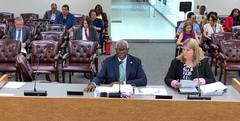
The program is not new, and the administration's pitch was continuity. Valda Ray-Lewis, the city's Office and Grants Administrator, told the committee the program is largely the same as last year's, with one addition: an in-person grant workshop for applicants.
What is new is the context.
What happened on the county side
The council's discussion of grant rules follows a year in which nonprofit grants steered by elected officials became a criminal matter in Shelby County.
Former Shelby County Commissioner Edmund Ford Jr. was federally indicted and accused of using his public office to secure grant funding for nonprofits. He pleaded guilty to five counts of tax evasion and attempted tax evasion.
(A necessary clarification, because the names are close and the distinction matters: Edmund Ford Jr. is a former county commissioner. He is not Councilman Edmund H. Ford Sr., who currently serves on the Memphis City Council. They are different people, and nothing in this story concerns Councilman Ford Sr.)
After the guilty plea, Shelby County commissioners debated eliminating their own grant program entirely. They ultimately voted to keep it.
Separately, city auditors questioned a $13,000 grant that was awarded to a County Commissioner-elect. That review happened on the city's side of the ledger, in the same grant apparatus the Council is now proposing to fund again at $2.6 million.
What the Council said
Council members expressed support for the program while acknowledging the shadow over it. Councilwoman Michalyn Easter-Thomas said she hopes this year's grant program proves to be as seamless as it needs to be, and as legitimate as it should be.
That is a notable thing for a council member to say out loud about her own program. It is also the entire question.
Why It Matters for Memphis
Council-directed grants are a genuinely useful tool. They let a member move a modest amount of money quickly to a neighborhood group that would never survive a competitive federal grant process: a youth program, a block association, a food pantry. The people closest to a district often do know where $200,000 will do the most good.
They are also, structurally, the single easiest place in city government for public money to become political currency. An elected official personally selects the recipients. The recipients are private organizations. The relationship between a member and a nonprofit is rarely examined until someone examines it.
That is not a hypothetical concern in Shelby County. It is a description of what a federal indictment already alleged happened here, and what a guilty plea has already partially resolved. The county looked at its own program afterward, considered killing it, and kept it. Now the city is renewing its version, at $2.6 million, with one added workshop.
The program may be fine. The point is that nobody outside City Hall can currently tell.
The Oversight Question
There is a clean way to run this program and a messy way, and the difference is not complicated.
The clean way: every award is posted publicly with the recipient, the amount, the purpose, and the council member who directed it. Members disclose any relationship with the organizations they fund. An auditor reviews the awards annually and publishes the review. None of that requires new law. It requires the Council to decide it wants to be watched.
The messy way is to renew $2.6 million, add a workshop, and hope.
Memphis just spent a year watching what happens when elected officials direct nonprofit grant money without anyone looking closely. The Council is about to vote on doing it again. The question is not whether the program should exist. It is whether anyone will be able to see it.
Update, October 11, 2026: Former Shelby County Commissioner Edmund Ford Jr., whose federal case this post cites, was sentenced on October 6, 2026, to two years in federal prison and two years of supervised release for tax evasion by U.S. District Judge Thomas Parker, FOX13 Memphis reported. Prosecutors said he failed to report more than $300,000 in wages; restitution will be set later. Bribery charges in the original case were dropped under his plea agreement and were never proven. Ford Jr. is not Councilman Edmund H. Ford Sr. The 901 Report's follow-up: "Former Commissioner Edmund Ford Jr. Sentenced to Two Years in Federal Prison for Tax Evasion".