Hearing #1: What Council Asked, What the Administration Said, and What's Still Missing
The first FY27 budget hearing in plain English - scored against the findings The 901 Report published before the gavel dropped.
Filed: May 19, 2026
Hearing: Memphis City Council FY27 Budget Hearing #1, Monday May 18, 2026
Source video: Watch the replay
The Bottom Line
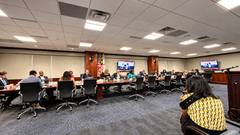
Memphis taxpayers got their first public look at how the FY27 budget will actually be defended. Three hours, four agenda blocks, eight Council members in the chamber. Mayor Young's CFO Chief Walter Person walked the room through the Capital Improvement Program (CIP), the operating budget, the Finance Division, and the Executive Division. Libraries took an out-of-order slot because the Executive presenter wasn't ready.
Here is the honest scorecard.
The Council asked real questions in some places - particularly Chair White on potholes, Councilman Warren on the missing $60 million debt cliff, Councilwoman Easter-Thomas on pre-K, and Councilwoman Green on the auto registration fee shortfall. Those moments were the hearing at its best.
But the questions The 901 Report flagged as the most consequential were largely not asked. Police overtime was not discussed (it's not in this hearing's scope, but Council members had the chance to preview it and did not). The proposed $13 million contractor-spending reduction was not interrogated. The Information Technology (IT) software-spending anomaly - 46.5% of the IT operating budget, nearly double the peer-city benchmark - was not raised once. The Tyre Nichols civil-trial fiscal exposure, set to begin 34 days after a budget vote, was not raised. The 311 system that has been promised since November 2023 was not raised.
And in one consequential exchange, the administration was allowed to redefine a public commitment without pushback. The Mayor's promise of "10,000 housing units" was reframed by Chief of Development and Infrastructure John Zeanah into the City "creating conditions for the increase of supply" - without the Council asking what that means in dollars, what the gap is, or what a unit-by-unit production target would require. The full HCD presentation explaining the strategy is not scheduled until June 9 - after the budget vote.
That is the headline of Hearing #1. The administration was allowed to defer the largest questions of the budget cycle to after the vote.
How We Scored It
The 901 Report published eight major findings in our pre-budget oversight review of Mayor Young's FY27 proposed budget. Each finding was a question the Council should be required to answer before voting yes. For this hearing, we tracked which findings came up, which got real answers, and which were left on the table.
We are not telling Council members how to vote. We are documenting the public record so Memphis taxpayers can see for themselves whether the elected officials they sent to City Hall are asking the questions a $898 million budget deserves.
What Council Did Ask - And What They Got
✓ The Debt Cliff Was Finally Explained
Councilman Warren has been asking for years where the promised $60 million debt cliff went. On May 18, Deputy Chief Andre Walker gave the first public, step-by-step accounting:
• Original cliff (as of June 30, 2020): $63 million
• After Accelerate Memphis bond issuances: narrowed to $51 million
• After the 2022 refunding (which front-loaded $17 million in present-value savings into FY22-FY26): narrowed to about $46 million
• After the March 2026 General Obligation (GO) bond issuance: narrowed to about $36 million
That's a useful disclosure. It also confirms the bigger picture: about $27 million of the original $63 million cliff was consumed by new borrowing and refunding choices made by the administration between 2020 and 2026. The Council was not asked to approve every one of those choices in real time as a tradeoff against the cliff. They were briefed after the fact.
Walker also disclosed two future refunding opportunities - about $5.1 million in present-value savings on the 2018 and 2016 GO bonds, plus about $3 million on the 2017 downtown Tourism Development Zone (TDZ) revenue bonds. The administration met with the Mayor about the GO refunding the previous week and got the go-ahead. State approval, then Council approval, then transaction - about three months for the GO, with TDZ a month behind because the bonds cannot be called until late August or early September.
Risk flag from Walker himself: rising interest rates from the war in Iraq have already added 20-50 basis points across the board. If rates climb further, the projected savings shrink.
The 901 Report's read: This was the most substantive disclosure of the hearing. Warren got the answer he had been asking for. Chair White was candid that she didn't follow all of it - "it sounds like you just speaking French" - and asked for a one-on-one explanation. That is healthy. What was not asked: why is the Council learning about a $36 million swing in the debt picture for the first time at a budget hearing rather than seeing it tracked in the quarterly reports throughout the year?
✓ Pre-K Got a Champion
The current Sales Tax Referendum Fund supports pre-K at $8.5 million this fiscal year - $7 million in standing commitment plus a $1.5 million one-time add via a writer to the budget. The FY27 proposed budget drops back to $7 million. Chief Person was explicit about why: the referendum fund is in deficit spending and "deteriorating."
Councilwoman Easter-Thomas put her flag down publicly:
"I do plan to go ahead and bring that just to let you know now so it was no surprise. But yeah, I think we do need to at least maintain what we were able to do last year because pre-K is definitely important. We're talking about potholes, but pre-K is definitely important."
She will bring the resolution. Chief Person said the administration would find a way to fund it - either from the referendum fund if it improves, or from the General Fund.
The 901 Report's read: This is exactly the kind of intervention the budget process is supposed to produce. A specific dollar amount, a specific Council resolution, a specific commitment on the record. Easter-Thomas earns a check mark here. The follow-up question Council should ask: if the referendum fund is "deteriorating," what is the multi-year trajectory? When does it stop being able to fund the standing $7 million at all?
✓ Potholes Became the Conversation They Should Be
Janika White (Super District 8-2), chairing the budget block, opened the discussion.
Chair White's opening speech on potholes was the most-quoted moment of the hearing for a reason:
"If you go and speak to our constituents, people talk about crime and those things. But the thing that I actually hear about - people don't come to me and say, what are you doing about crime? I can tell you in the last month, no less than a hundred people have stopped me and asked me about what are we doing about our streets and potholes."
The numbers in response: $6.5 million in expense recovery (historical), plus two new lines of $6.75 million each for asphalt paving streets group one and group two. About $20 million dedicated to paving in FY27. Plus an asphalt plant rehabilitation line aimed at lowering production cost per ton so the same dollars pave more roads.
Councilman Warren made the politics of it clear: "Maybe we need $40 million. Maybe we need $60 million. I don't know what we do, but that is huge." Chairwoman Swearengen-Washington added the equity layer - make sure the dollars are spread across the city, not concentrated.
The 901 Report's read: Council pushed and the administration responded with specifics. This is a model exchange. The remaining question - which White flagged herself - is how the $20 million in FY27 compares to recent years' actuals, and whether the asphalt plant rehab actually produces the promised cost-per-ton reduction. We'll be tracking those numbers in the monthly reports.
✓ The Auto Registration Fee Audit Question
Councilwoman Green did something important. She didn't just accept the explanation that the fee is underperforming. She pointed out that the County had the same problem, did an audit, found "numerous problems," and saw collections rise after. Chief Person admitted the City has not taken that next-level dive because the relevant data lives at the County Clerk's office and the City does not independently verify those numbers.
The fee was supposed to deliver $27 million. It's tracking toward $22-23 million. The shortfall is roughly $5 million in money that voters approved specifically to support MATA.
The 901 Report's read: Green did exactly what Council oversight is supposed to do - connect a current City problem to a documented County remedy and ask why the City has not adopted it. Person's answer, in essence, was we cannot independently audit a County office. That answer is correct on its face but it is not a closure. The follow-up Council should demand: a written request to the County Clerk for a coordinated audit, with a defined timeline. Otherwise the $5 million shortfall becomes structural.
What Council Should Have Asked But Didn't
This is where the hearing got worse the longer it ran.
✗ Police Overtime - Not Touched (But Heading Into Police Budget Day)
The 901 Report's finding: Police overtime is budgeted at $29,826,387 - the lowest proposed level in recent years - despite four consecutive years of actual spending between $35 million and $42 million. No written operational plan was provided explaining how the $5-12 million reduction will be achieved.
Council members had the operating-budget block to preview the question - particularly when Chief Person was discussing "operational pressures" and explicitly named "overtime and staffing demands" as one of the City's biggest challenges. No one followed up. The single line he used - "we know they're going to be a challenge this year" - was allowed to stand without anyone asking what specifically is different in the operational plan that justifies a number this much lower than the four-year actual average.
This question must be asked on Police budget day. If it is not, Memphis will be voting on a number that has no plan behind it.
✗ Contractor and Consultant Spending - Reduced $13 Million With No Explanation
The 901 Report's finding: Contractor and consultant spending is proposed at $39.4 million - $13 million below the current FY2026 forecast of $52.7 million - with no explanation of how that reduction will be achieved.
Chief Person briefly mentioned that "legal and professional service costs" have been rising and the administration is dealing with insurance contracts going "much higher than they used to be." That is the opposite of an explanation for a $13 million reduction. It is an explanation of increasing cost pressure.
Councilman Warren raised the topic of contractors at the Joint Office of Neighborhood Safety, but only in the context of replacing lost state grant funding. No Council member asked about the citywide $13 million contractor reduction or the FY2026 Q1 Executive Division report that confirmed contractors were hired because positions were frozen.
This is a $13 million question with no answer in the public record.
✗ The Information Technology (IT) Software Spending Anomaly - Zero Mentions
The 901 Report's finding: The IT Division's software-license spending represents 46.5% of its total operating budget - nearly double the peer-city benchmark of approximately 27% - with no software asset inventory, no license utilization audit, and no rationalization plan.
This was a budget hearing where Finance presented its Enterprise Asset Management initiative - a citywide system to track all the things the City owns, primarily fleet. Chief Person was direct about the diagnosis: Memphis has over 5,000 items in rolling stock and Person had only recently learned the City didn't have all the ownership certificates in one central location.
That admission is striking. If the City does not know where its fleet titles are, how confident should the Council be that the City knows how many software licenses it owns, how many are utilized, and how many are duplicated across divisions?
The answer to that question is in the IT Division's budget - which was not on the agenda for May 18, but which Council members could have foreshadowed by asking whether Enterprise Asset Management will extend to software as well as fleet. It did not come up.
✗ The Tyre Nichols Civil Trial - Zero Mentions
The civil trial begins July 13 - 34 days after the proposed June 9 budget vote. The City has previously characterized the exposure as something that could "bankrupt Memphis." There is no contingency reserve line in the proposed budget for civil judgment exposure.
This was not raised once.
✗ The 311 System - Zero Mentions
The City announced a "revolutionary" Esri/ArcGIS 311 upgrade on November 27, 2023. Two and a half years later, the system has not been delivered. On April 14, 2026, the IT Division returned to the Economic Development, Tourism & Technology Committee asking for $403,500 for what they called a "new software solution." Councilwoman Cooper-Sutton stated on the record at that meeting that IT had failed to appear for two prior scheduled presentations. The committee held the request and demanded a demonstration before transferring the money.
Eight weeks later, on the floor of a budget hearing, none of that was mentioned. Including by Councilwoman Cooper-Sutton, who is in the chamber and is the same Council member who held that request in April.
This is the cleanest possible example of a pattern The 901 Report has been documenting: the same questions get raised once in committee, then disappear when the bigger spending decision actually comes to the floor.
✗ The "10,000 Housing Units" Promise Got Quietly Redefined
This is the moment of the hearing The 901 Report flags as the most consequential - and the easiest to miss.
Chair White asked a direct question about the Mayor's announced 10,000 housing units goal: where, in the budget, is the path to that goal? She named it as priority number two from the State of the City address.
Chief John Zeanah answered. He told Council that the full HCD presentation will come to the HCD committee at its first meeting in June (June 9). And then he said this, on the record:
"If you recall from the Mayor's address, the City is not funding all 10,000 housing units. We're creating conditions for the increase of supply of housing to a goal of 10,000 units by 2030 through a variety of different factors. Funding and financing is one of them, but regulatory and infrastructure support is one. Land availability is another."
Chair White noted that the June 9 presentation will arrive after the budget vote and let the point land - but did not push further.
Three things to note about Zeanah's answer:
1. The promise was redefined in public, unchallenged. "10,000 housing units" became "creating conditions for the increase of supply" - a fundamentally different commitment.
2. The dollars in this budget for the goal are unclear. The CIP shows $1 million for middle-income housing infrastructure in FY27, scaling up in subsequent years, plus $13.7 million for Southwest Twin (which includes a police precinct, library, and fleet maintenance building - not 10,000 housing units).
3. The full strategy presentation comes after the vote. This is the same structural problem as the 311 question: the substantive accountability moment is scheduled to happen after the moment that matters.
The Council should be asking: if the City is not funding 10,000 units, what is the City funding, what is the gap to 10,000, and what mechanisms are being used to close that gap? The Council should also be asking: why is the strategy not presented before the budget vote that funds it?
✗ The Joint Office of Neighborhood Safety Engagements - $15 Million Gone, Plan Unclear
This was the closest the hearing came to a real fiscal-exposure conversation, and Councilman Warren deserves credit for forcing it onto the record. The Joint Office's operating budget is $1.26 million - almost entirely personnel and operations. The expected $15 million in state funding was pulled. The administration is "in talks" with state and federal partners, no grants awarded yet.
Chief Adams pushed back on the "$15 million gap" framing - said they're not looking to replace every grant dollar dollar-for-dollar; it's a ramp-up effort. Adams later disclosed that $3.5 million of additional violence-reduction funding sits in the Police budget via the VISA grant for the same initiatives, and another $1 million comes via the Safer Communities grant supporting roughly 43 organizations. So the integrated picture is closer to $5.7-$6 million in total funding for the work the Joint Office is meant to coordinate.
Two things missing from the conversation:
• The County's contribution to a joint city-county office was not disclosed. Chair White asked for it but the answer was deferred.
• The Police-budget portion ($3.5 million via VISA) means Council will not see the full Joint Office funding picture until Police presents - which is the same pattern of fragmenting accountability across hearings.
The 901 Report's read: Warren did the right thing by forcing the framing. The follow-up question for Police budget day: produce the consolidated funding ledger that shows every dollar across every division flowing to Joint Office-coordinated work, with grant expiration dates and the documented backfill plan. Without that ledger, "ramp up" is a word, not a plan.
The Smaller But Real Wins
Libraries presented well. Director Eric D. Harris came to the table with an organizational diagnosis, a reorganization already executed, part-time hours restored from 20 to 28, four new social workers funded inside the existing budget, and partnerships with Code Crew and HopeWorks. He was honest about HVAC pressure ($100,000+ this year) and explicit that he is choosing to handle it pay-as-you-go rather than ask Council for more. Councilwoman Logan's challenge to him - "are you putting pen to paper so that you won't have to come in the middle of the year and say hey, you know, it's more than a notion and we didn't accommodate?" - was the kind of mid-year-risk question every division should be asked.
The Office of Youth Services scaled from 1,800 to 3,000 students with 450 business partners (up from 170), a new monitoring app called Mlock, and a third-place steak finish out of 28 youth teams at the Memphis in May barbecue competition. Director Brian Harris delivered.
Animal Services committed to specific staffing numbers - 8 Animal Control officers in place by July, 4-5 more in FY27, additional vehicles, weekend coverage - and to a multi-track veterinarian plan (one part-time vet-of-record, three relief vets, one contracted with potential to convert, plus a staffing-veterinary-service contract). Chairwoman Swearengen-Washington and Councilwoman Cooper-Sutton both pressed for this and got named commitments back.
These are the moments where City Hall worked in May 18. They deserve to be noted alongside the criticisms.
What Chair White Said at the End - and Why It Matters
The closing remarks from Chair White went beyond the FY27 budget and named what every honest observer of the May 18 hearing must conclude:
"Us budgeting for today is great. It is going to help us make it through the rest of this year. But it's not going to change the direction that we're going as a city in total. So does that look like new bond issuances? Does that look like tax increases? Oh my gosh, I just said the worst thing in the world. But the reality is that we are a city that really needs to be funded."
She called for a "true mental health facility." She called for a structured residential option for at-risk youth. She challenged EDGE, the Chamber, and other recruitment organizations to take trips to Silicon Valley and Seattle to bring new business to Memphis.
The 901 Report agrees that this is the bigger question, and we will be tracking it. But the bigger question does not absolve the smaller ones. A balanced FY27 budget with a $13 million unexplained contractor reduction, an unsubstantiated police overtime number, and a $1.26 million line for a function the State just pulled $15 million from - is not a balanced budget. It is a budget waiting to be unbalanced in real time once the fiscal year starts.
The Running Questions List
Chair White made a procedural change worth highlighting: starting at this hearing, the budget analyst is logging questions live and the administration is expected to return with written answers at the next hearing. As of May 18, the running list includes:
1. Speed-hump maintenance responsibility, inspection cadence, and the split between temporary vs. permanent humps in the FY27 budget
2. The new median planting maintenance plan and cost
3. The state law on pothole damage claims (Tennessee Code Annotated cite)
4. The full 10,000 housing units strategy (HCD committee, June 9 - after budget vote)
5. The auto registration fee underperformance drivers and whether the City will request a coordinated audit
6. Identification of who in city government is responsible for exploring new revenue streams
7. The separate-fund detail for the 26% xAI community/education set-aside
8. The consolidated Joint Office of Neighborhood Safety funding picture (Joint Office + Safer Communities grant + Police VISA grant)
9. The County's contribution to the Joint Office
10. Animal Services staffing bridge between now and July 1, plus full FY27 needs breakdown
11. Library central-branch bathroom redesign before sign-off
12. The pre-K $1.5 million resolution (Easter-Thomas, forthcoming)
Questions The 901 Report would add to that list before the next hearing:
13. The written operational plan supporting the $29.8M police overtime budget - who authored it, when was it written, when does Council see it?
14. A complete contractor inventory by division - vendor, scope, annual cost, whether work could be performed by employees if positions were filled
15. The basis for the $13 million proposed reduction in contractor and consultant spending
16. The IT software asset inventory and license utilization audit
17. The 311 system proof of concept (held by committee April 14, never delivered)
18. The Tyre Nichols civil trial exposure briefing - exposure range, contingency plan, reserve question
19. A 10-year and 20-year pension projection with independent actuarial analysis
20. The FY26 Q1 Executive Division contractor-vs-frozen-position reconciliation
Next Hearing
The FY27 budget hearings continue. Police is expected next, and that hearing is where the largest single set of unanswered questions from The 901 Report's pre-budget review will need to be put on the table.
We will be watching. We will be tracking. We will be publishing.
About this briefing
The 901 Report is Memphis's independent civic accountability organization. We read the budget cover to cover, verify every figure against the source documents the City itself publishes, and track every word the administration says in public hearings against the commitments already on the record. We are not affiliated with any political party, candidate, or government agency. Every figure in this briefing is sourced to public documents and to the publicly recorded May 18, 2026 hearing. The full hearing transcript and our pre-budget oversight findings are available at the901report.com.